
Meet The Crediton Town Band...
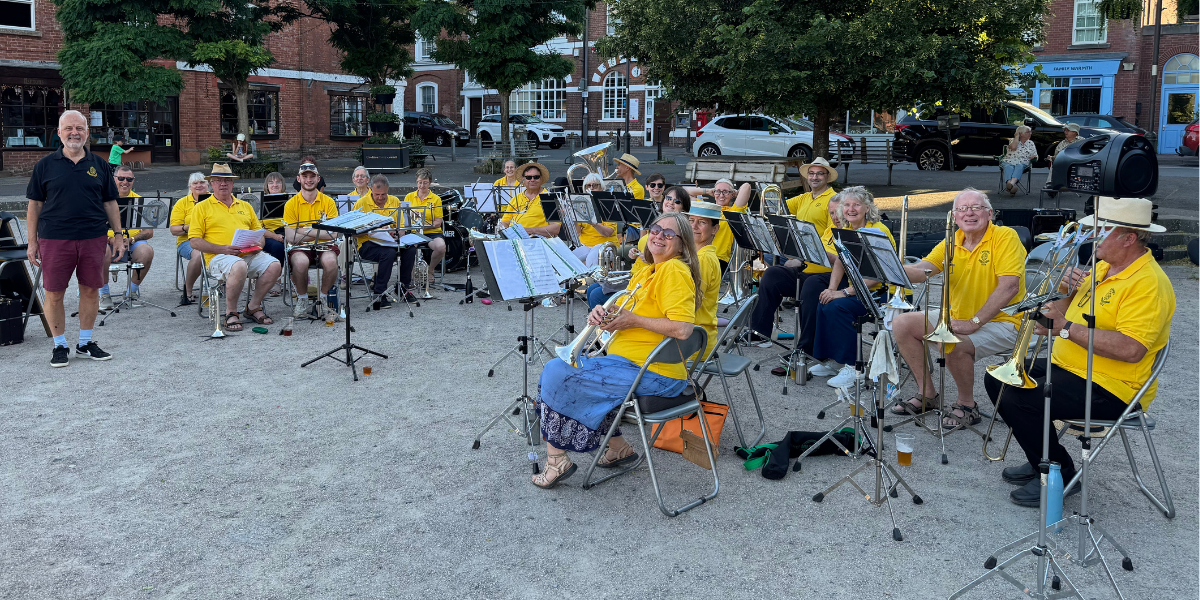
Traditional brass bands all share the same combination of instruments, arranged in sections. It’s this combination that gives brass bands their unique sound. Typically, a full brass band would have the following line-up:
- 1x Eb Soprano Cornet
- 9x Bb Cornets (arranged into 4x Solo Cornets, 1x Repiano Cornet, 2x Second Cornets and 2x Third Cornets)
- 1x Flugel Horn
- 3x Tenor Horns (arranged into solo, first, and second horn)
- 2x Baritone Horns
- 2x Euphoniums
- 2x Tenor Trombones
- 1x Bass Trombone
- 2x Eb Basses
- 2x BBb Basses
- Drums / Percussion
Being a traditional brass band, the Crediton Town Band follows this configuration, although the numbers of players in different sections can vary. Here’s how we’re laid out:
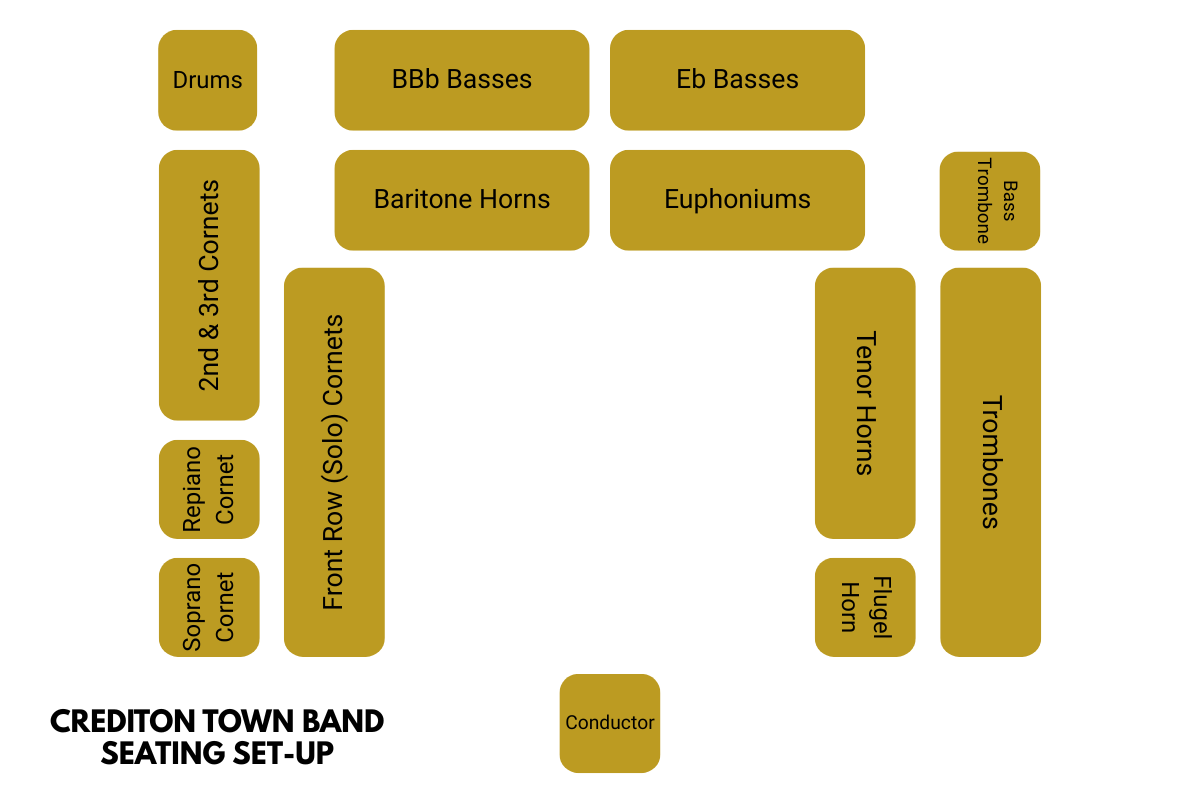
We aren’t a contesting band (meaning we don’t compete with other bands in competitions) so we can be flexible with how many seats are in each section at any time.
Check out the following profiles to find out more about the instruments and some of our wonderful players…
Caroline - Cornet
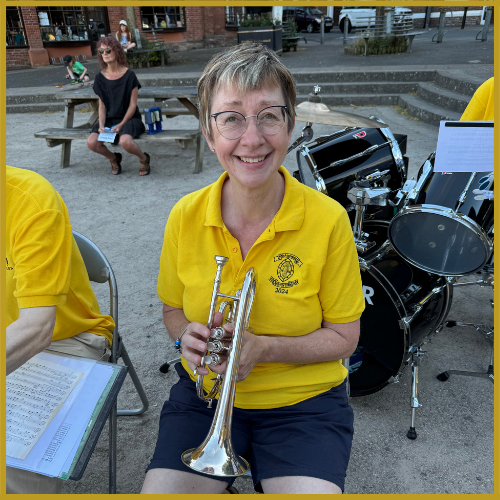
About Caroline…
I have been playing the cornet since January 2022. I learnt the piano and cello as a child and have always loved music, particularly enjoying playing in a youth orchestra and singing with others. I enjoyed listening to the brass band and always hoped to get the opportunity to learn a brass instrument when I had time.
Playing the cello in an orchestra made me wish I’d learnt a brass instrument sooner - ideally one I could carry more easily! I retired in 2020, and after hearing the band play carols, I approached the band and finally got started with brass.
I enjoy so many aspects of playing with Crediton Town Band. The joy of playing alongside others, the sound of the band, and the way that being a small part of the whole is so rewarding. The challenge of learning the instrument and learning new pieces of music is something I love, but most of all I value being a part of a great group of people who have a common goal and enjoy each other’s company.
About the cornet…
The cornets are the highest pitched instruments in the band, and we usually get to play the melodies. That’s a lovely thing to do, but it also comes with a bit of pressure to make sure you get the notes right, as you’re often the main instrument that people are listening to.
It takes lots of practice to build up your embouchure (lip muscles) for the high notes!
However, because there are three or four cornet parts, with 3rd and 4th cornet parts generally being simpler music, not only was I able to play with the band from shortly after starting to learn, but I often play off-beat rhythms, counterpointing with the baritones, euphoniums and basses. That relieves a bit of pressure, but counting and getting the rhythms right can be a challenge in itself!
What advice would you give to a beginner player?
Make sure you have some lessons to get the hang of the technique. Learn to read music, as this really helps. Practice little and often, and try to play with others as soon as you can.
Kate - Flugel Horn
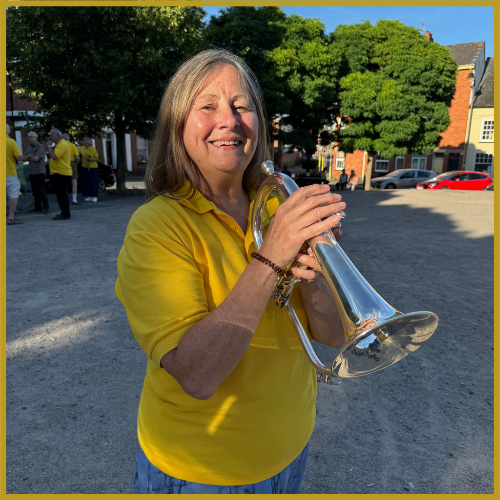
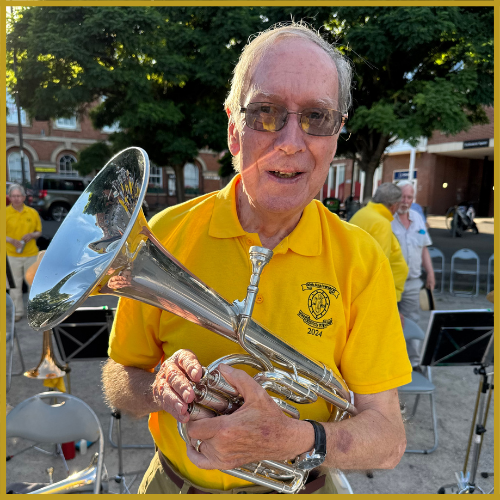
Eric - Tenor Horn
About Eric…
I learnt to play the tenor horn in 1953 when I joined the Salvation Army in Nottingham. I progressed to the senior band, where I played cornet, before leaving the Salvation Army just short of my 20th birthday in 1960. I didn’t play again until 1988 when I was recruited to play 2nd horn in the Crediton Town Band. I was promoted to 1st horn, which is my position with the band today. Overall, I have played with the Crediton Town Band for 38 years!
It sometimes feels like I’ve played with the band for so long, and it means so much to me, that it’s become a part of my identity. It certainly gives me a strong sense of belonging and genuinely feels like family.
About the tenor horn…
The tenor horn is a constant link between all sections of the band, as it can blend beautifully with the higher cornets and the lower baritones and euphoniums. I love the beautiful mellow sound, and its relatively compact size means it’s easy to carry and transport to engagements.
The range of music we play demands that horn players need to be able to play across the whole register of high and low notes, which can sometimes be a challenge. Because we often shift between playing melodic lines and providing rhythmic accompaniment (often in the same piece of music) keeping in time can be a challenge.
What advice would you give to a beginner player?
Don’t give up! Keep practicing, enjoy getting better and do not expect anything too soon.
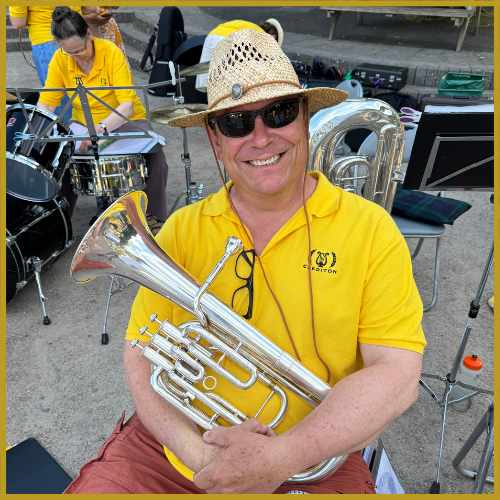
Rich - Baritone
About Rich…
Although I now play the baritone, I returned to music five years ago, about 40 years after last playing trumpet at school. I started on Bb bass, which was a gentle(ish) reintroduction to music for me although, like all instruments, it has its particular challenges. I’m now retired and play something somewhere six days a week!
Playing in a band is all about sharing time with others. When you get it right, it’s thrilling, compelling and a really fun team sport. Crediton Town Band is an extremely social community group, and this is reflected in how many of its players count their membership in decades!
About the baritone…
The baritone is a brilliant instrument to play. The mouthpiece is pretty big and comfortable and lets you play for a long time before you get tired. It also has a pitch around that of a male voice, so if like me you can’t sing but wish you could, the baritone is a great place to be.
The main challenges of the baritone are also its best features, in that the role requires a lot of variety and you play different functions within the band. It’s not usually a key melodic or bass instrument but is often used to support and contrast these sections so you get to play response melodies and countermelodies as well as a lot of syncopated rhythms.
Other than being the harmonic glue between the upper and lower sections of the band, it doesn’t have a specialist role as such, but you get involved in a bit of everything, which means you can enjoy playing with different sections of the band from one minute to the next.
What advice would you give to a beginner player?
Don’t feel embarrassed, even the best players couldn’t toot for toffee when they started so you have something in common with everyone from the off! Join the best band you can, ask lots of questions and listen to all the advice other players have to offer; they are very generous and happy to help you on your journey. Work hard and remember to have fun!
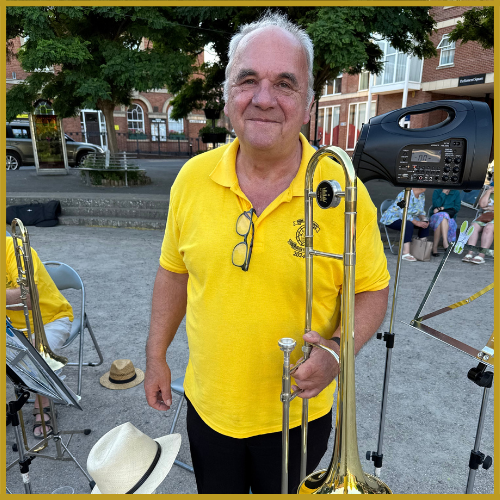
Steve - Trombone
About Steve…
I have been playing for 55 years. I started on trumpet in 1971 after my music teacher discovered I could get a note out of it. Five years later I joined the Army as a bandsman and changed to trombone due to a shortage of trombone players and an excess of trumpet/cornet players! After serving 18 years in the Army, I left and joined Crediton Town Band.
Mostly we play music that I like to play, even though a brass band is not what I was used to after playing in a military wind band for so many years. It’s nice to feel part of a group and I have made many friends.
About the trombone…
The trombone is one of the most versatile and challenging instruments in the band. Other brass instruments have valves to help you choose which note to play whereas the trombone just has a slide, so you need to have a good ear to stay in tune.
The trombone player needs to play in 3 different clefs: treble, tenor and bass. Brass bands mainly use treble clef (and occasionally tenor clef), whereas in a wind band it’s primarily bass clef. The trombone is used for the lower end of the music and we often bridge the gap between the basses and the rest of the band. The slide can also be used for comical effects when used to play glisses!
What advice would you give to a beginner player?
Find somewhere where you can get a free loan of an instrument as they can be quite expensive to buy, especially if you’re not too sure about which one to play. Once you start, don’t give up too quickly. You may find it quite difficult at the start, but I promise you it does get easier, especially if you practice every day.
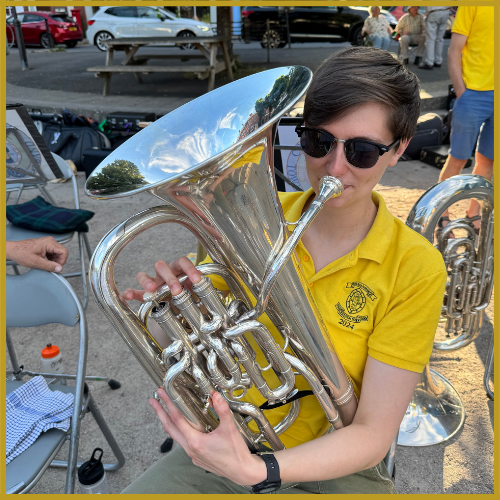
Katie - Euphonium
About Katie…
Hello! I’ve been a part of the Crediton Town Band for about four years now. I joined after re-learning my childhood instrument (trombone) over lockdown and rekindling my love of brass. Since then, I have moved to the dark side (valved instruments!) and haven’t looked back. I love being a part of the band and getting to make music with such wonderful people!
Thursday night rehearsals are the highlight of my week. I’ve been challenged musically in lots of ways - most recently by playing euphonium - and have really developed as a player over the past few years. I’ve also met some amazing people along the way.
About the euphonium…
I like playing low brass as we provide the ‘heart’ to most pieces. You are there to complement the wider band, but do still get your moments to shine. The euphonium is the glue that connects the cornets to the basses, which sometimes means you get beautiful melodies to play, and sometimes you just get off-beats.
Both the baritone and euphonium also have beautiful tones, but one of the challenges is that you have to really listen to the music playing above and below you and not just focus on the ‘twiddly bits’.
What advice would you give to a beginner player?
Don’t be afraid of making mistakes. That is what practices and rehearsals are for!
James - Bass
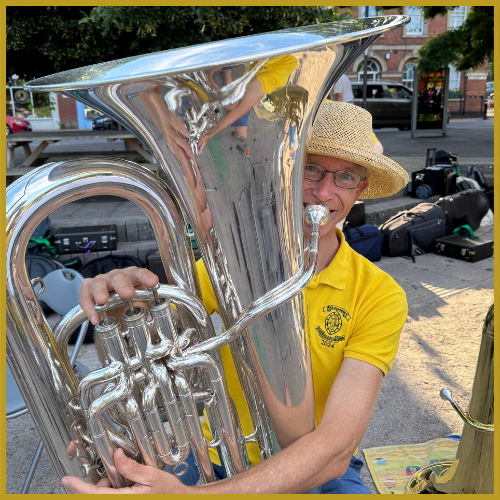
About James…
I learnt piano and clarinet at school, but never well enough to play outside of the school concert band. At age 40, when my youngest son was learning cornet, his teacher asked us to look after a tuba after a carolling session with the throwaway line, “If any of you want to learn it by next Christmas, it would be really useful.”
I thought “why not?”. I learned from his beginner cornet books and joined the band one year later, and 16 years on, I’m still here!
During a busy week at work, rehearsals are an escape. The musical director is responsible for the decisions, and I can just get absorbed in the music and fit in as one of the team. When everyone watches and listens it’s like being part of a well-oiled machine (which I like, as I’m an engineer!).
About the bass…
The bass parts are never too complicated, usually as much rhythm as tone. As the lowest instrument I like to growl the notes that nobody else can reach.
The weight and size of the bass can be a challenge, and a lot of breath is needed when playing loud. Once you get the hang of that, playing super-quietly can be a challenge too! The basses provide the basis of the harmony and keep the rhythm going - we provide the ‘oom’ in the traditional ‘oom-pah’ brass band sound.
What advice would you give to a beginner player?
My advice would be to cancel the gym membership if you play bass - you get your fair share of weight lifting and deep breathing!
Claire - Drums/Percussion
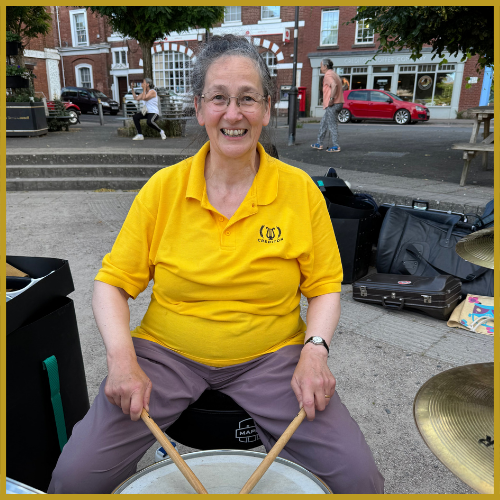
About Claire…
When this band reformed in 1984, one of the lads in my maths class played drums. In conversation with him, I mentioned that I had played the timpani at school. Next thing I knew, I was playing 2nd percussion in Crediton Town Band. I played the big bass drum (even marching up the High Street with it strapped to me), timpani (the two big kettle drums tuned to different notes), the glockenspiel (for which you need an elementary knowledge of the piano keyboard) and various strange bits and pieces like claves (two lumps of wood knocked together), tambourine, marching cymbals, sleigh bells, triangle, sandpaper blocks and cowbell. Yes, percussion certainly has some variety!
The band is such a friendly bunch. I never feel judged if I do something wrong. I am made welcome and always feel part of the family. There are a real mix of professions and ages in the band - it crosses boundaries and never feels cliquey. And playing with the band is FUN! I always come away from practice buzzing.
There are wonderful moments when a cymbal crash is placed just right or the drums start a whole piece off. But I like being a foundation for the band too, giving a rhythm for the brass to sit on.I even enjoy not being needed when the band plays a piece without any percussion and I can sit back and listen and hear how the music develops as it is rehearsed. When you do play, you can’t be a shy retiring violet, and when you go wrong, everyone notices. There can be a whole page of repeating bars and then a sudden silence in the whole band. Woe betide you if you miscount!
About the drums/percussion…
Often the drums need to be the pulsing drive behind the band. Sometimes you are the whisp of icing on the cake with a cymbal flick, but you are behind and underneath most of the time. There are pieces where you are the canvas upon which the melodic music is painted. There are also pieces where you have a prominent part, but mainly you are the rhythmic foundation and driver of tempo.
What advice would you give to a beginner player?
You are never too young or too old to learn, but don’t expect the percussion section to be the easy option.
Remember, if you’d like to learn to play a brass instrument, absolutely free, then check out our learn to play page or email
Permanent playing members of the Crediton Town Band receive a copy of this Players' Charter defining the requirements, expectations and responsibilities of membership.